Policy Brief
RECEPD No. 2023 – 002
August 2023

This policy brief is a collaborative effort based on data analysis and research discussion among the following researchers affiliated with the Research Consortium on Education Policy and Development in the Greater Bay Area (RECEPD), HKIER:
Dr. Dongshu OU
Dr. Yan CAO
Dr. Kenneth K. WONG
Ms. Maggie FOKThe Greater Bay Area has a complex and diverse educational system. The Guangdong-Hong Kong-Macao Greater Bay Area encompasses 11 cities, including 2 Special Administrative Regions (SARs) and 9 cities with varying levels of economic development. Disparities in economic conditions and educational development among these cities result in an uneven distribution of educational resources. A glance of the education landscape in the Greater Bay Area will facilitate a deeper understanding of the educational challenges and opportunities within this diverse region.
The development of education quality in the Greater Bay Area plays a key role in the overall GBA development. First, a high-quality education system can effectively cultivate and attract talents, provide a strong pool of human resources, and promote the development of economic growth, science and technology, and culture. Second, high-quality education helps to improve citizens’ quality of life and promote social progress and innovation, aligning with the goals of the Greater Bay Area development plan.
The pupil-teacher ratio is a standardized indicator used to measure education quality in different phases of education in different areas. It is calculated by dividing the number of students by the number of full-time teachers in each educational phase. A lower pupil-teacher ratio indicates a smaller class size, suggesting that students have greater access to teachers and instructional resources. The education literature indicates that smaller class size generally has a positive effect on student learning. In an aggregated level, pupil-teacher ratios tend to be lower in the more economically developed cities with adequate educational resources.

In relation to primary education levels, the average pupil-teacher ratio in primary schools in the GBA region is about 18, which is significantly higher than the national average ratio (16.67) as well as the average ratios in the provinces of Jiangsu (16.79), Zhejiang (16.79), Shanghai (14.01), and Beijing (14.01).
In terms of regional disparities, the pupil-teacher ratio in Hong Kong and Macau is about 13, indicating readiness to allocate resources in schools in the two SRAs Conversely, ratios in the other 9 cities generally exceed 18, suggesting that teacher resources are relatively limited. Moreover, the ranking of the pupil-teacher ratio in 9 mainland cities reflects a strong correlation with their respective economic development levels. Cities experiencing higher economic development, such as Shenzhen, Guangzhou, and Foshan, demonstrate relatively lower ratios, approximating the GBA average. While cities with slower economic development exhibit higher pupil-teacher ratios. Dongguan is the only exception; despite its accelerated economic growth in recent years, a significant shortage of teacher resources persists.
Pupil-teacher ratios in most of the 11 GBA cities have been gradually decreasing between 2015 and 2020. However, in Zhaoqing, the ratio experienced a slight increase. A possible reason may be due to the slowing down of outmigration of young families to pursue better employment opportunities outside of the city.
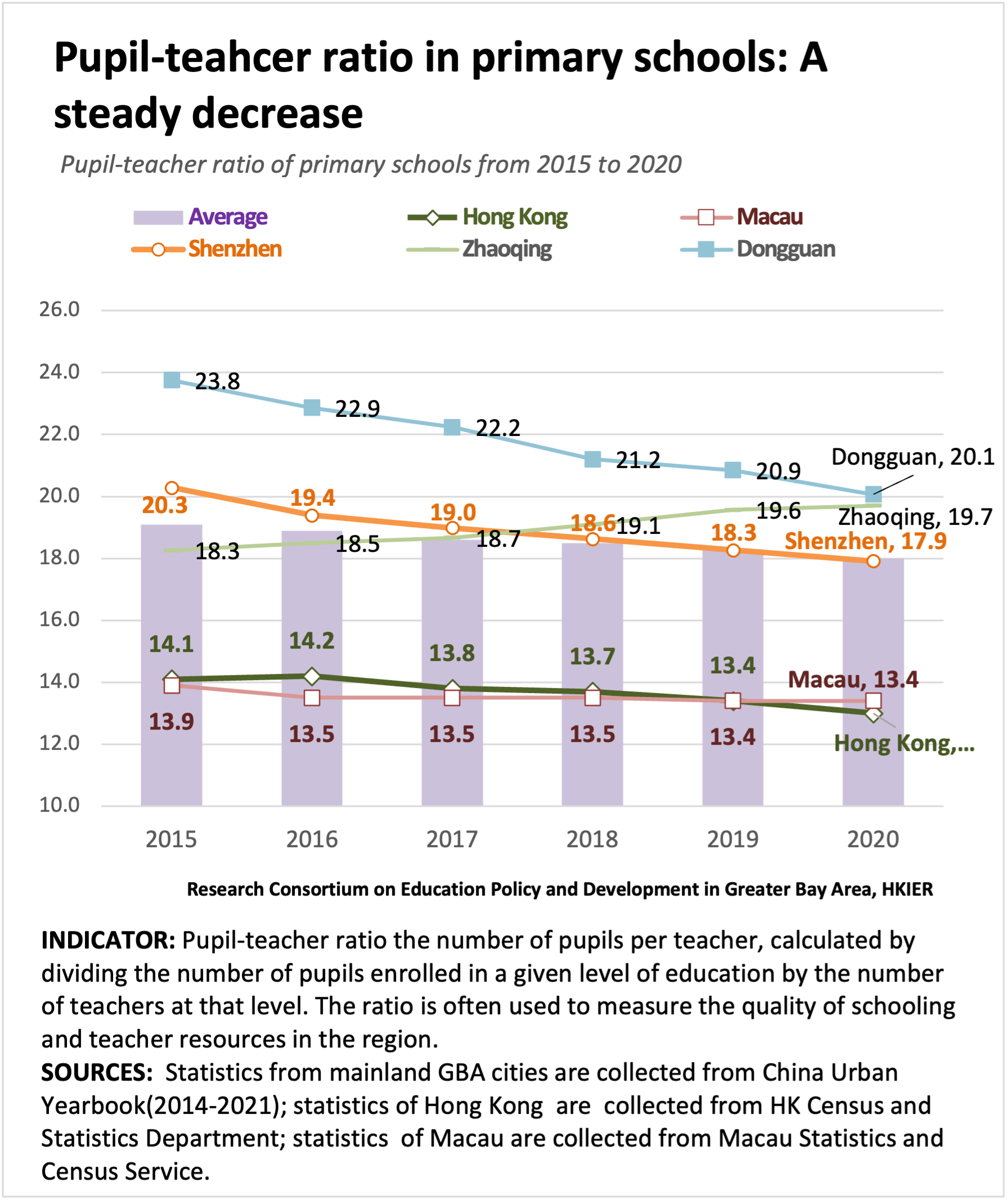
Despite the relatively high pupil-teacher ratio in the primary schools of the Greater Bay Area (GBA), a notable improvement has been observed from 2015 to 2020, with the average ratio in the GBA decreasing from 19.1 to 18.0. Hong Kong’s primary schools have experienced a continuous decline in their pupil-teacher ratios, moving from 14.1 in 2015 to 13.0 in 2020. Macau has maintained a relatively stable level of 13.4 throughout this period. Meanwhile, the trend can be also observed in Dongguan and Shenzhen, where the pupil-teacher ratio has consistently declined from 23.8 to 20.1 in Dongguan and from over 20 to 17.9 in Shenzhen respectively. Despite an increasing pupil-teacher ratio in the less developed city Zhaoqing, the overall progress made in the region with regard to pupil-teacher ratios could potentially contribute to improved educational opportunity for students.
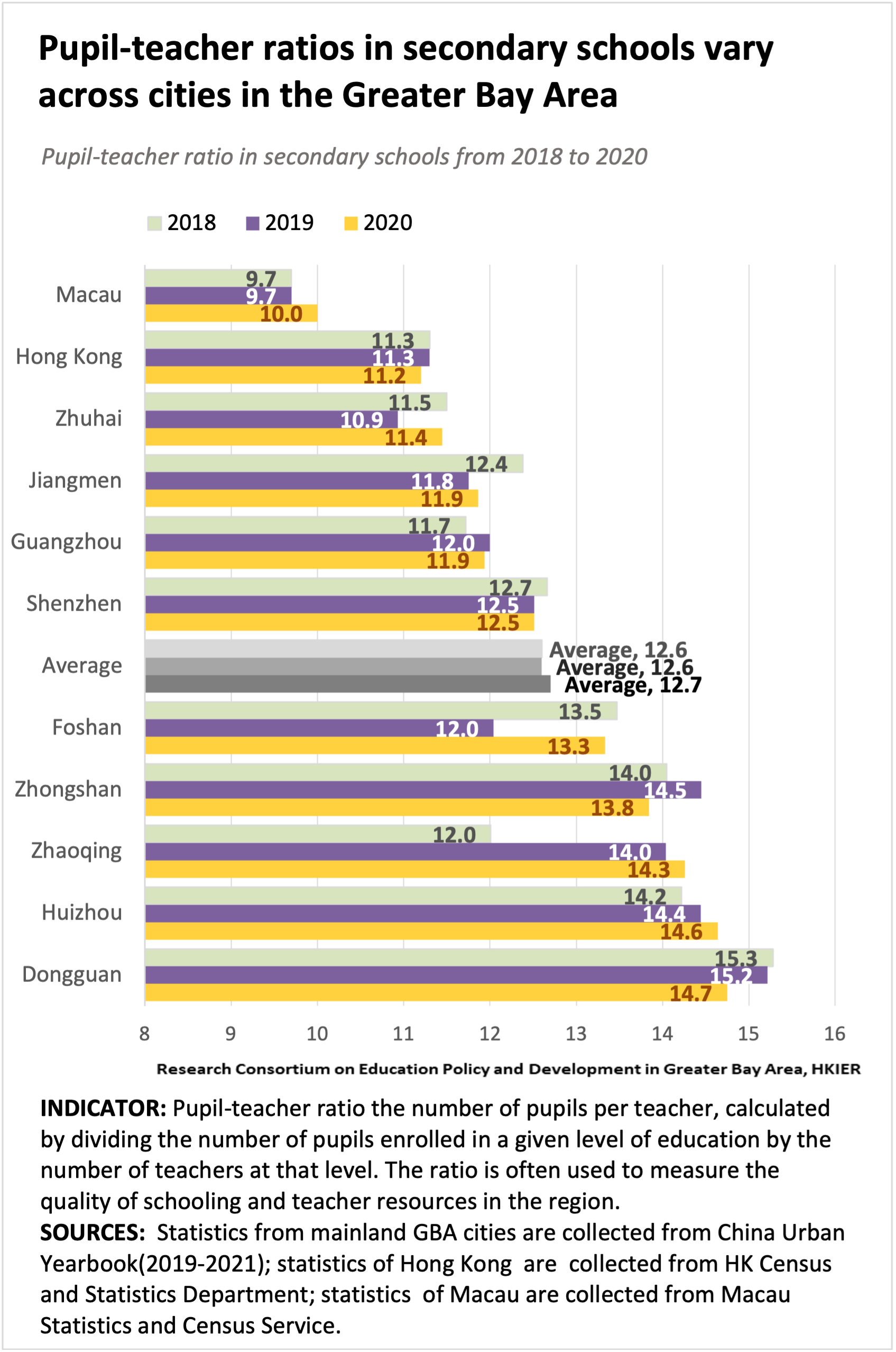
The Guangdong-Hong Kong-Macao Greater Bay Area (GBA) has maintained a stable pupil-teacher ratio in its secondary schools, averaging 12.7. This figure is equivalent to the average level found in mainland China (12.8) but higher than that in Jiangsu (11.5), Zhejiang (11.7), Shanghai (9.7), and Beijing (8.1). Among the nine cities in mainland China, Zhuhai (11.4 in 2020), Jiangmen (11.9 in 2020), Guangzhou (11.9), and Shenzhen (12.5) have a lower pupil-teacher ratios than the GBA average, while other cities display relatively higher ratios. Dongguan, in particular, continues to face with the most acute teacher limitation issue, evidenced by a ratio of 20.1.
Over the past three years, certain fluctuations have been observed in the pupil-teacher ratios across individual cities within the GBA. Both Zhaoqing and Huizhou have experienced a year-on-year increase in their ratios, suggesting that further attention is required to address these disparities and improve the overall quality of education in the region.
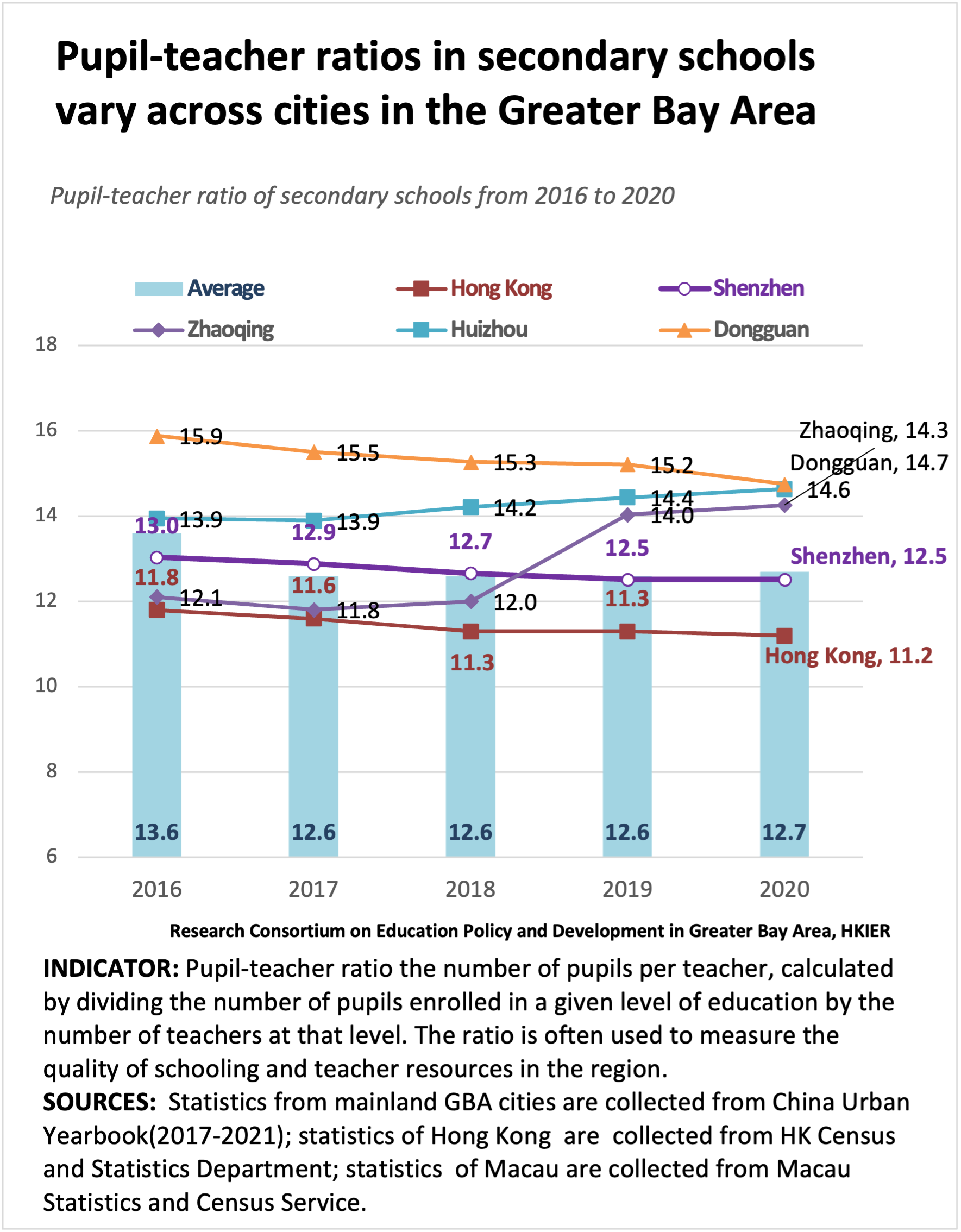
In examining the changes in the pupil-teacher ratio during 2015 and 2020, it is apparent that cities with a higher level of economic development, such as Hong Kong and Shenzhen, have exhibited a gradual decrease in their pupil-teacher ratios on a year-to-year basis. This trend suggests a correlation between economic development and improvements in educational conditions.
On the other hand, cities with higher growth rates, such as Dongguan, have been observed to exhibit a more gradual decline in their pupil-teacher ratios. This may indicate that the rate of economic growth also plays a role in shaping the educational landscape and addressing disparities in pupil-teacher ratios.
Simultaneously, Huizhou and Zhaoqing have experienced a steady increase in pupil-teacher ratio. Huizhou’s ratio has risen from 13.9 in 2015 to 14.6 in 2020, while Zhaoqing has experienced the most visible increase, with its ratio rose from 12.1 in 2015 to 14.3 in 2020. These escalating trends necessitate further investigation and possible intervention to ensure the provision of quality education in these cities.
In light of these findings, it is crucial to consider both the level of economic development and the changing economic conditions of a city when analyzing the factors that contribute to changes in pupil-teacher ratios. A deeper understanding of these dynamics can help inform targeted strategies to improve educational opportunities across the region.
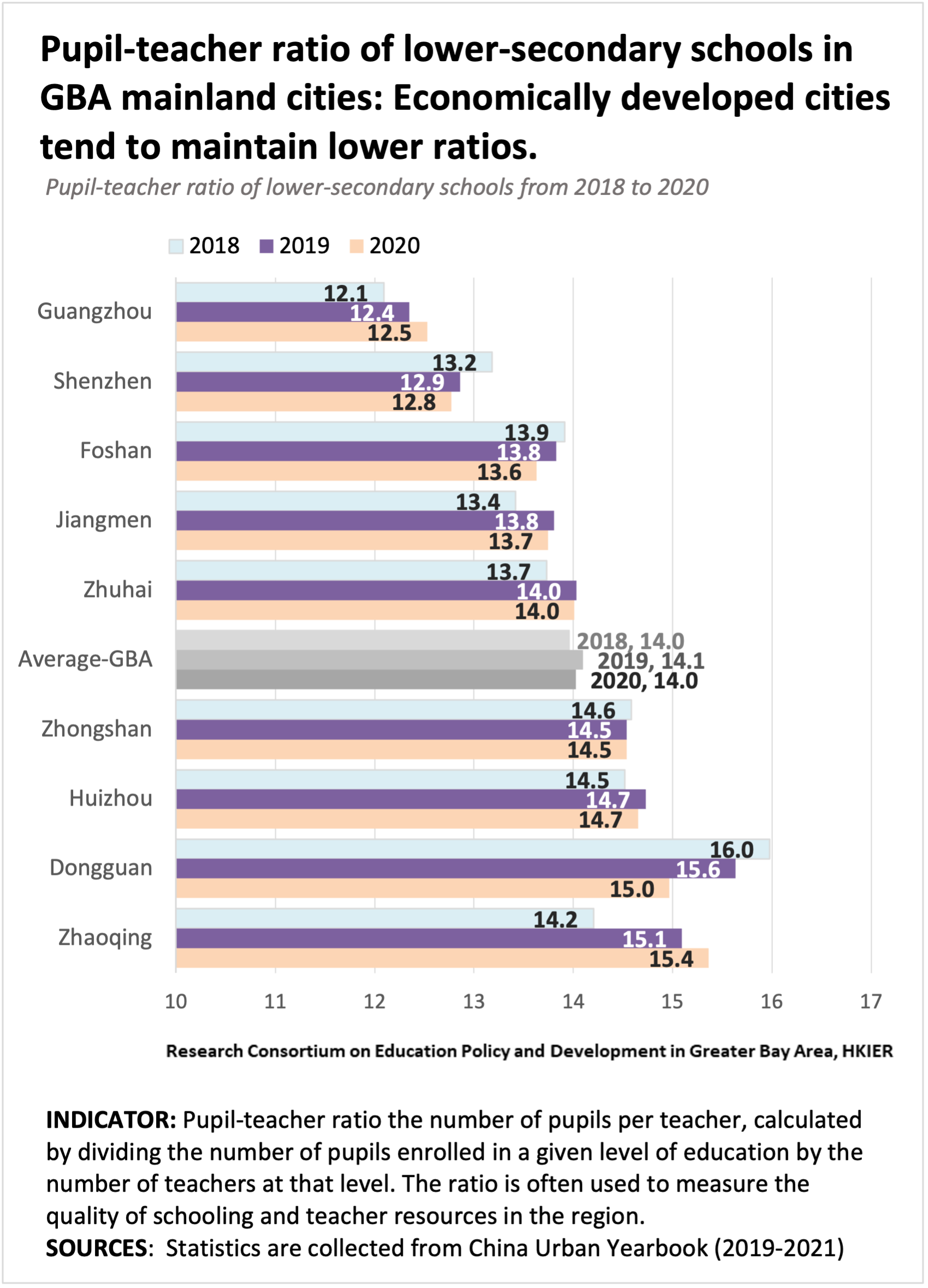
The average pupil-teacher ratio in mainland cities within the Greater Bay Area (GBA) stands at 14.0, exhibiting minimal changes during 2018 to 2020. This ratio is relatively higher compared to the average ratios in mainland China (12.7), Jiangsu (12.0), Zhejiang (12.3), Shanghai (10.5), and Beijing (8.7).
During the middle school stage, Guangzhou holds a leading position in terms of pupil-teacher ratio among other mainland cities within the GBA. However, the ratio has demonstrated a slight upward trend between 2018 and 2020. In contrast, Shenzhen ranks second among the nine cities and has displayed an opposite pattern to Guangzhou, decreasing from 13.2 in 2018 to 12.8 by 2020, which resulted in a minor difference with Guangzhou in that year.
Middle school pupil-teacher ratios in Foshan, Jiangmen, Zhuhai, Zhongshan, and Huizhou are distributed above and below the average level of the nine cities. Specifically, Foshan (13.6), Jiangmen (13.7), and Zhuhai (14.0) are slightly above the average, while Zhongshan (14.5) and Huizhou (14.7) fall below. Examining the three-year trend, Foshan shows a modest decline year by year, while the other cities maintain a certain level without much changes.
Notably, the pupil-teacher ratio in Dongguan’s middle schools has experienced significant improvement over the three years, moving from 16.0 in 2018 to 15.0 in 2019. However, due to the severe shortage of teacher resources, the ratio remains at the bottom, even after the substantial improvement. In comparison, Zhaoqing ranks last, with the pupil-teacher ratio in middle schools reaching 15.4 in 2020. More importantly, the ratio in Zhaoqing’s middle schools continues to exhibit an upward trend year by year.

The disparities in pupil-teacher ratios across various cities within the Greater Bay Area become more evident when examined over the period from 2016 to 2020. While the average level of the nine cities has remained relatively stable, there are marked differences among individual cities.
Notably, Shenzhen and Dongguan have demonstrated significant improvement in their pupil-teacher ratios, based on their original education resource levels. Shenzhen’s ratio has decreased from 13.3 in 2015 to 12.8 in 2020, while Dongguan’s has reduced from 16.3 to 15.5.
In the middle school stage, the pupil-teacher ratio in the Guangzhou area has experienced a slight increase, rising from 12.0 to 12.5 in 2020. In contrast, the pupil-teacher ratio in Zhaoqing’s middle schools has been escalating year by year, moving from 13.4 in 2015 to 15.4 in 2020. Given that Zhaoqing’s economic development lags behind that of other cities, the increasing pupil-teacher ratio implies a serious shortage of local teacher resources.
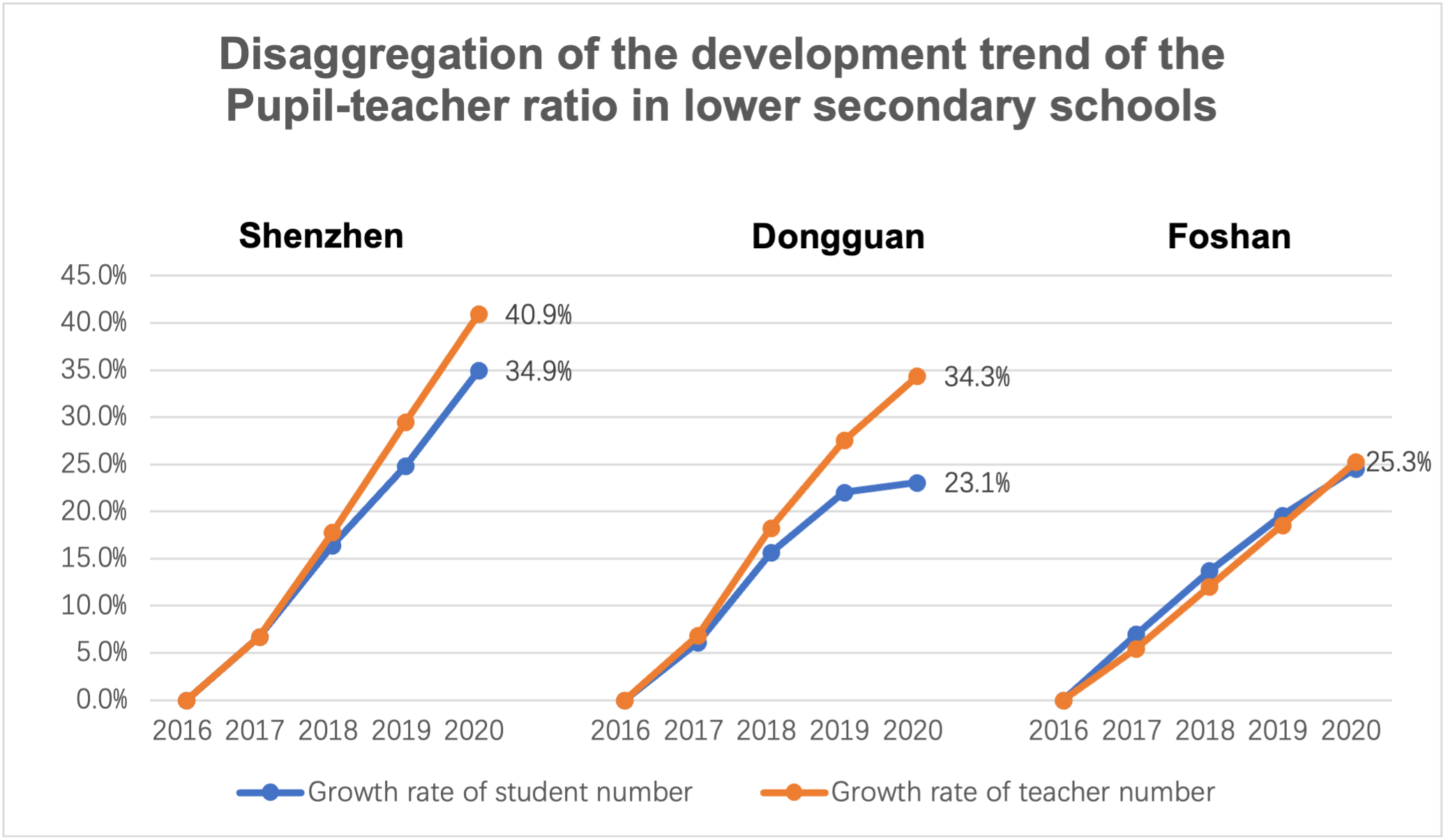
By disaggregating the changes in the number of students and teachers in various cities behind the pupil-teacher ratio during 2016 to 2020, we further analyze changes in the pupil-teacher ratio in the nine mainland cities.
Overall, the number of lower secondary schools students in the nine mainland cities has grown to various degrees during the five years. Considering the increase in full-time teachers in lower secondary schools, the growth rate of teachers in Shenzhen, Dongguan and Foshan is greater than the growth scale of the number of students.
During 2016 through 2020, the number of lower secondary teachers in Shenzhen has increased by 40.9%, significantly higher than the growth rate of junior high school students during the same period (34.9%); Dongguan followed closely with a 34.3% increase in teachers and a 23.1% increase in students; The number of teachers and students in Foshan has basically maintained steady growth at the same time, achieving a balance between supply and demand of education to some extent.
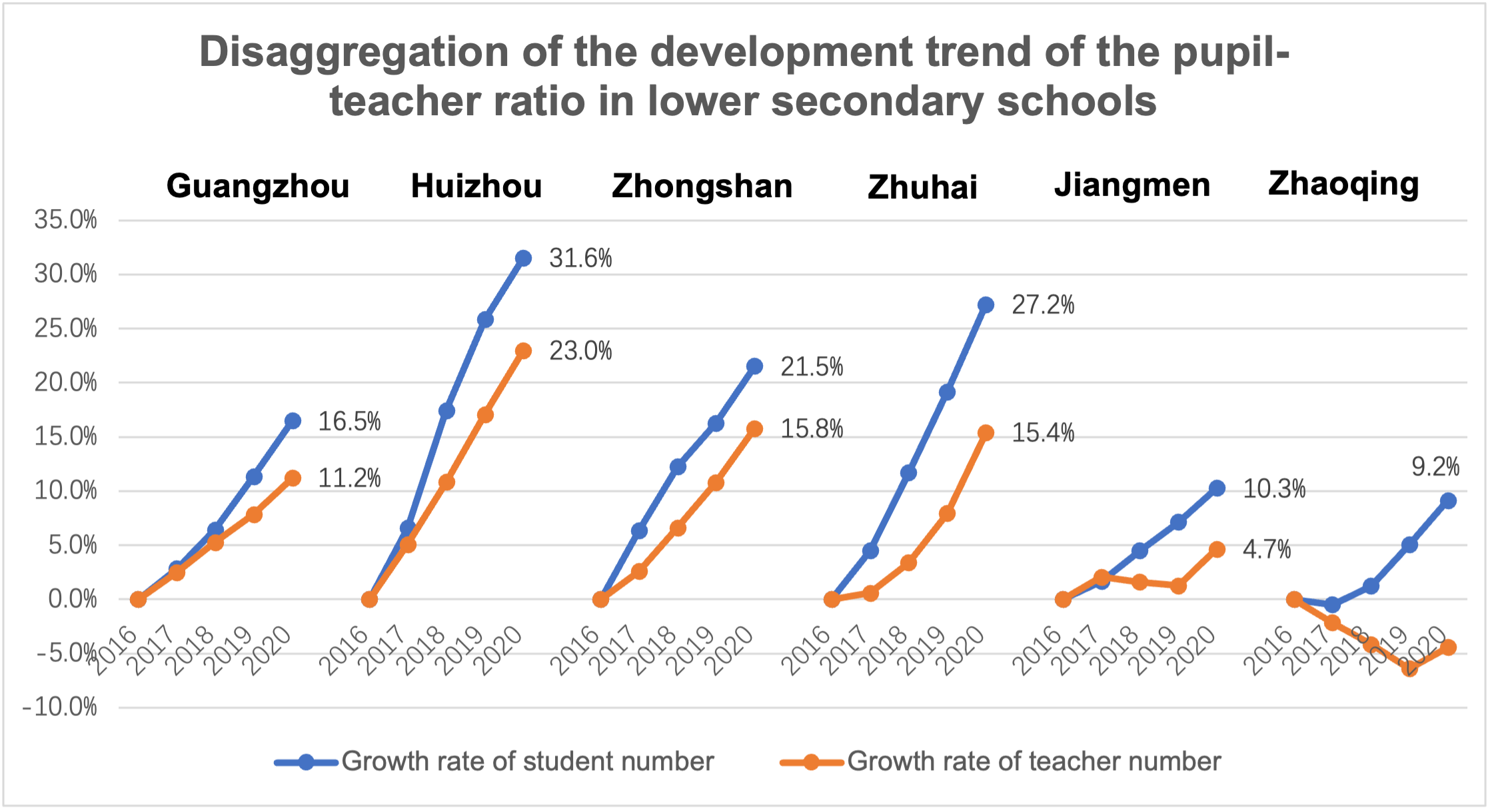
Within the Greater Bay Area, six cities exhibit clear indications of teacher shortage, struggling to keep pace with the growing student population. The teacher resource shortage in Guangzhou is relatively mild. Over the five year period, the number of lower secondary school students has increased by 16.5%, with a corresponding teacher growth of 11.2%. However, Huizhou, Zhongshan, and Zhuhai are confronting significant increases in the number of lower secondary level students, with growth rates reaching 21.5%-31.6% in the past five years. Meanwhile, the growth of relevant full-time teachers ranges from 15.4% to 23.0%. A widening trend in the teacher gap is particularly evident in Zhuhai.
Although the growth in the number of students in Jiangmen and Zhaoqing is not substantial (with increases of 9.2% and 10.3% respectively), their need to maintain their teaching force remains critical. In Jiangmen, the number of teachers has grown by only 4.7% over the five years. Zhaoqing faces the most severe teacher shortage. The city has not only been unable to cope with the increasing number of students, but the number of teachers has also decreased annually. Compared to 2016, the number of full-time teachers dropped by 6.4% in 2019 and, despite a slight rebound in 2020, still decreased by 4.4%.
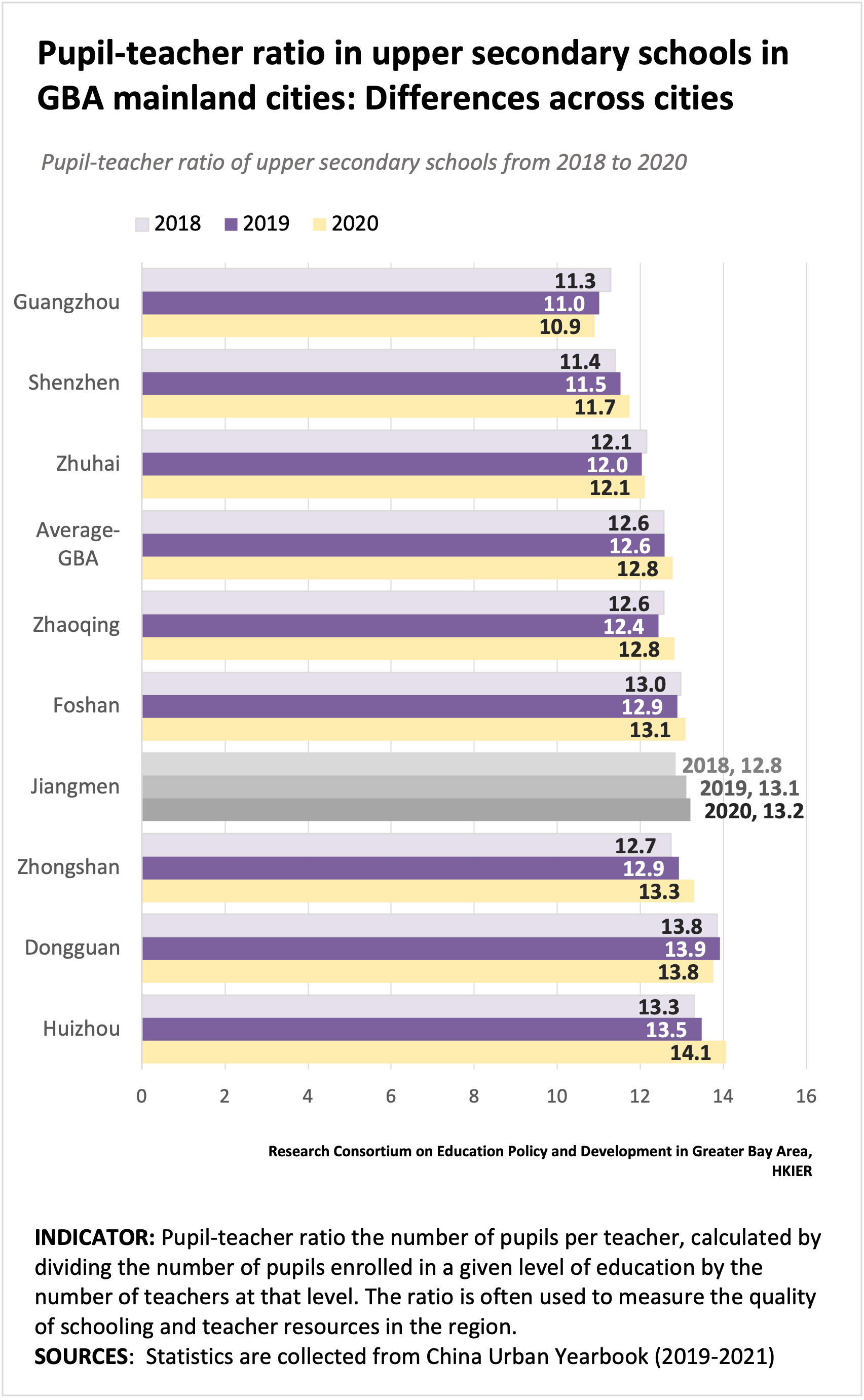
In the ordinary high school stage, the average pupil-teacher ratio of the nine cities in the Guangdong Province’s Greater Bay Area (GBA) is 12.8 in 2020. This figure is exactly the same as the average level in mainland China in 2020 (12.9), but considerably higher than that of other economically advanced provinces or cities (Jiangsu and Zhejiang at 11.0, Shanghai at 8.7, and Beijing at 7.6).
The GBA cities with pupil-teacher ratios that are better than the average level include Guangzhou (10.9 in 2020), Shenzhen (11.7 in 2020), and Zhuhai (12.2 in 2020), ranked in ascending order.
In 2018 to 2020, pupil-teacher ratio in Huizhou has exhibited an increasing trend, which indicates that the existing teacher workforce is unable to accommodate the student population.

According to the 2016-2020 trend of typical cities in the Greater Bay Area, Guangzhou and Dongguan are the two major cities where the pupil-teacher ratio has been decreasing annually. In Guangzhou, the pupil-teacher ratio in ordinary high schools has continued to decline from 12.3 in 2016 to 10.9 in 2020, reflecting the city’s sound resource base. In Dongguan, the ratio decreased from 14.1 to 13.8, with a relatively modest reduction. On the other hand, the pupil-teacher ratio in Huizhou has been increasing year by year, suggesting the city’s relatively limited resources.
This policy brief highlights two primary aspects of the uneven distribution of teacher resources among cities in the Greater Bay Area (GBA). First, there are noticeable disparities in the pupil-teacher ratios among individual cities in the GBA. Cities with higher levels of economic development tend to maintain lower pupil-teacher ratios, particularly in primary schools, as compared to cities with lower levels of economic development. In contrast, cities with a lower level of economic development may exhibit increasing pupil-teacher ratios, as their existing teacher workforce struggles to accommodate the growing student population.
Second, as workforce migration into GBA cities continues to rise, a significant gap in the pupil-teacher ratio between primary and secondary schools may emerge. This disparity may be attributed to the differences in educational resources allocated to accommodate the increasing migrant population across various educational levels.
As the GBA embarks on educational coordination efforts, it is crucial to consider strategies that address these gaps across cities and educational levels. Policymakers may need to focus on redistributing educational resources, investing in teacher training, and implementing targeted recruitment strategies to attract and retain qualified educators in under-resourced areas. Furthermore, collaboration and resource sharing among cities within the GBA could be encouraged to promote more equitable access to quality education for all students, regardless of their geographical location or family status.




Room 204, Ho Tim Building, The Chinese University of Hong Kong, Shatin, N.T. Hong Kong
(852) 2603 6850
©2023 ReCEPD, CUHK. All rights reserved. Powered by Techcomm.